
Before the Crisis Call: Our 2026 Content Series

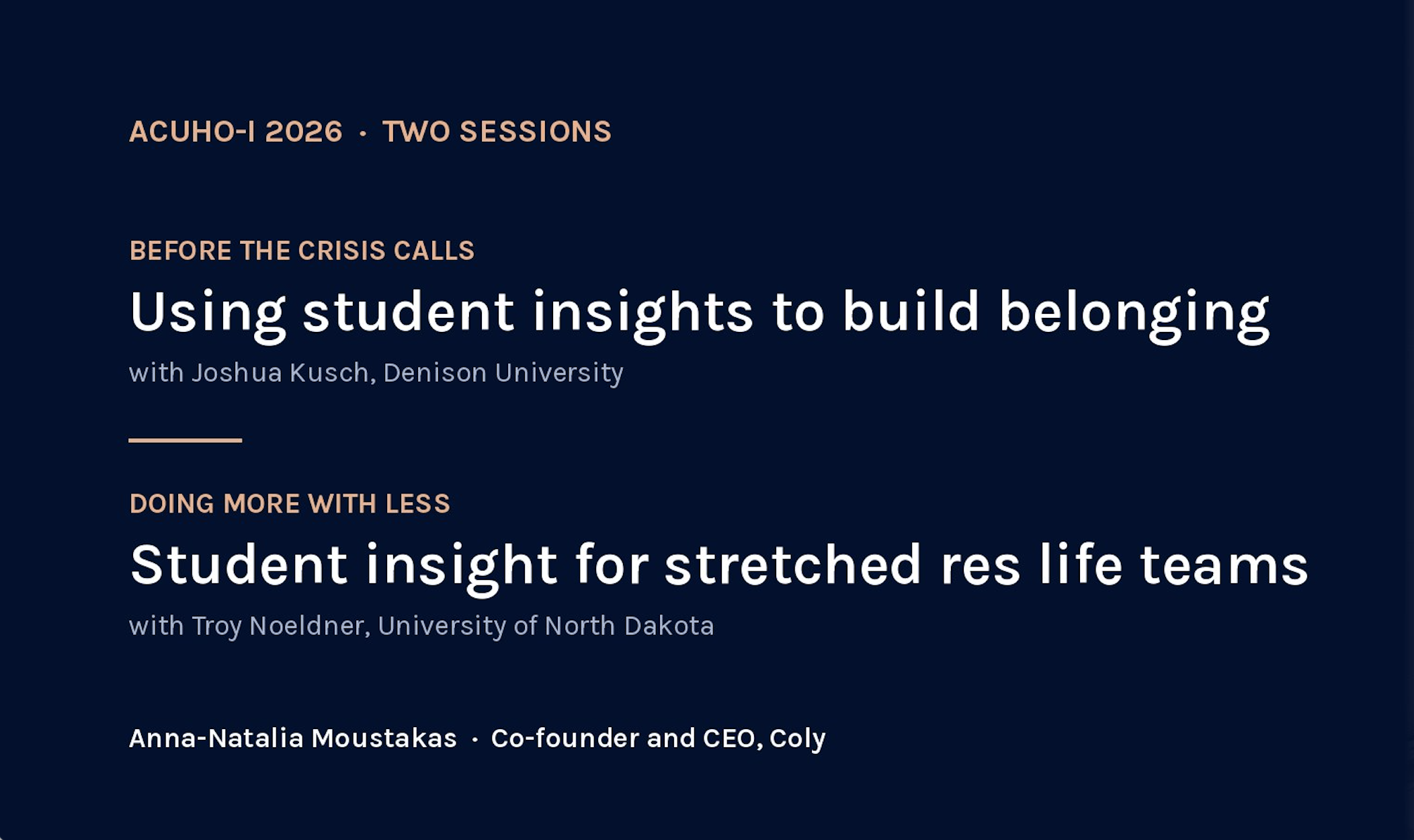
This October our CEO Anna Moustakas had the privilege of presenting two sessions as part of our 2026 Content Series, together with two partners we admire a lot: Josh Kusch from Denison University and Troy Noeldner from the University of North Dakota.
Two very different campuses. One small, private and fully residential. One a public flagship with 3,000+ students on campus. But both sessions landed on the same idea: we can't act on what we don't see.
So many of you came up afterwards and asked for the slides. Thank you! You can download both decks at the bottom of this page and here. Here is the short version.
Session 1: Before the Crisis Calls: Using Student Insights to Build Belonging
With Joshua Kusch, MSEd, Senior Director for Residential Communities & Housing, Denison University
The roommate relationship has never mattered more for whether a student thrives and stays. Yet most housing applications still ask about bedtimes, guests and how tidy you are. Those habits change with context. They are guesses, and matching on them is a bit like roulette.
Josh and I walked through a four-step framework for roommate success:
- Lay a more solid foundation. Add stable traits (personality and values) next to habits and interests. Ask about tendencies with neutral framing, like "After a long day, do you recharge by being around people or by having time alone?"
- Offer tools for conversation. Roommate agreements built on real situations, quick tips for tension, and clear paths to support.
- Reach in with early intervention. Short, multilayered check-ins: How are things with your roommate? Do you have a friend on campus? Are you thriving?
- Review your data. Year after year, so it informs systemic change.
In its first year with this approach, Denison saw clearly fewer students dissatisfied with their roommate by October, and far fewer reporting challenging conflict. The data also showed how much a single friendship matters: students without a friend on campus were many times more likely to signal they were thinking about leaving.
Session 2: Doing More With Less: Student Insight for Stretched Res Life Teams
With Troy Noeldner, Director of Housing & Residence Life, University of North Dakota
In ACUHO-I's December 2025 straw poll of 194 institutions, 65% had implemented hiring freezes, 48% had eliminated positions and 15% reported layoffs. Most res life teams are managing more students with fewer people.
We looked at burnout through the Job Demands-Resources model. High demands don't have to lead to burnout. Burnout happens when high demands meet low resources. So when you can't add staff, you can strengthen three resources and lower demands upstream:
- Coaching: guidance tailored to the student and the moment.
- Autonomy: knowing students early enough to plan instead of react.
- Feedback: pulse check-ins on who has made a friend and who is struggling.
- Lower demands: students who understand how they communicate handle more small conflicts on their own.
Troy shared how UND puts this into practice across the year: RAs get insight into the "personality" of their floor before move-in, programming is built around who students actually are instead of reactive interest surveys, short check-ins run mid-semester, and RA time shifts from mediation to mentorship.
The common thread
On day one we usually know a student's grades, hometown and age. We don't know how they communicate, what they value, how they react under stress or what they need to belong. That is the part that decides whether a floor works.
When staff can see below the surface, they get to plan instead of react. And students who understand themselves need staff less for the small things, which leaves more room for the work RAs actually signed up for.
Two questions to take back to your team:
- What data do you already have that could make your programming more tailored to each student group?
- How are you building students' self-awareness and communication skills so they can navigate conflict on their own?
A huge thank you to Josh, Troy and everyone who joined us, shared on Menti and stayed to talk afterwards. If you want to compare notes on your campus, reach out at anna@coly.io. I'd love to hear how you're thinking about this. :)
Get both slide decks
Download the slides here by adding your email, and both Content Series 2026 presentations are yours.
Stay in
the loop
Receive updates on Coly's journey, latest news, and new resources.